Common sense marketing for real needs and real limits
Common sense marketing does not ask how many features can be added. It asks what the client needs, what the client can comfortably manage, what risks should be respected, and what each element is supposed to accomplish.
More capable technology was genuinely on the table here and was discussed openly: direct scheduling, online payments, appointment deposits, product inventory, an administrative or client portal, and further automation. Each option was explained alongside what it would accomplish and what she would have to manage to keep it working. She chose a simpler operating model. More automation was available — it was not imposed, because the simpler request-based process better fit her preferences, capability, and safety needs.
Privacy and personal safety were treated as genuine design requirements rather than preferences to be talked out of. Search support was added proportionately, once she understood it and asked for it. And the level of technical responsibility she carries was her call too, not a default: she chose to have the website hosted and maintained for her. The system was designed for actual use rather than maximum feature count.
This is not an argument that simple is always better — the Northern Arizona real estate engagement is a good example of a far more integrated build with the client holding the keys. The point is fit: the right system, and the right support arrangement, for the person, the business, the constraints, and the goals it is meant to serve. And that approach included explanation, not just production.
When she asked whether this would help her rank in Google
Fultz Visibility did not offer a vague promise. A client-specific visual guide was created to explain what the website contributes, what Google controls, what supports visibility over time, and what she could do to support visibility without managing the technical infrastructure.
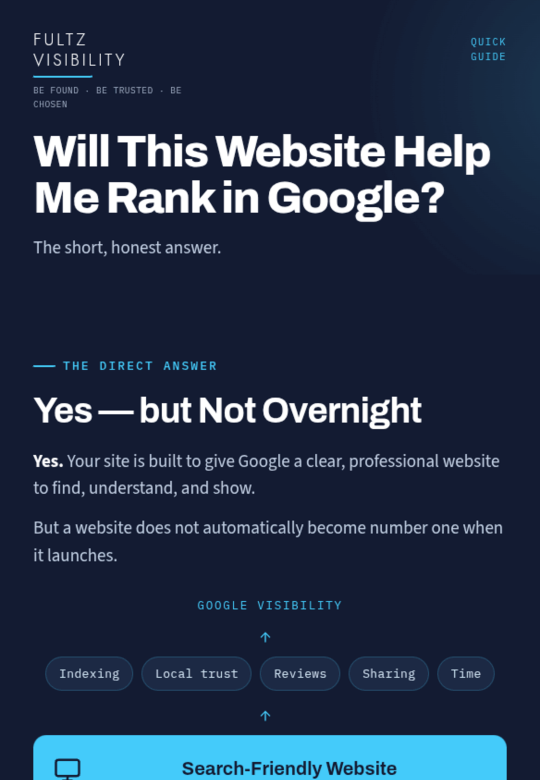
What the guide explains, in plain language
- The website is the foundation of ranking — not the entire ranking process.
- Google has to discover, read, and index the site before it can appear at all.
- Being indexed means eligible to appear. It does not mean ranked, and it does not mean first page.
- Search structure, reviews, local information, sharing, advertising, and time each contribute differently.
- Advertising can bring visitors sooner, but it does not directly improve organic ranking.
- The practical first goal is a strong launch, then honest visibility development over time.
The guide sets realistic expectations. It does not promise rankings, traffic, or results — and it is shown here as evidence that client education was part of the work, not as a performance claim.
The completed website, built from the ground up
The website itself is a dedicated site built specifically for her business and hosted by Fultz Visibility at her request. It presents her work, answers common questions, and routes appointment inquiries to her without requiring her to manage the technical infrastructure.
The website, the brand presentation, the filterable portfolio, the service information, the reviews and credibility surfaces, and the appointment-request pathway were all created in this engagement. Later refinements expanded that same foundation. Nothing on the site was inherited from a previous provider.
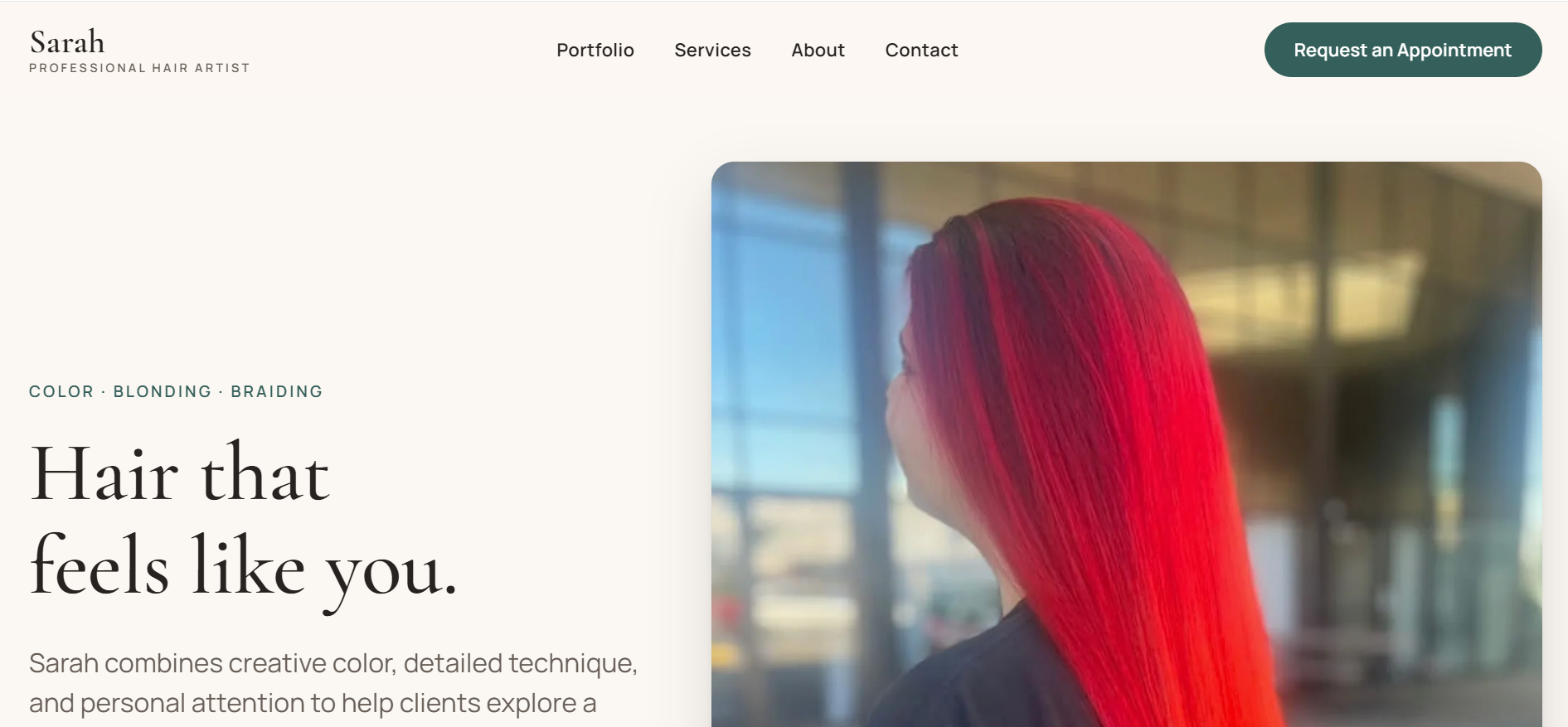
The completed public-facing website — built from the ground up and shown as implementation evidence you can inspect.
The completed public-facing website — built from the ground up as a portfolio, credibility, and appointment-request system the client can inspect, share, and use while Fultz Visibility handles hosting and technical maintenance on her behalf. This is implementation evidence, not a measure of traffic, rankings, or bookings.
Visit the Sarah Stylz Hair websiteThe client brought the work — the public system was built around it
The client already had the work, experience, and preferred way of serving people. Fultz Visibility created the public identity and website system that allowed those strengths to be shown safely and professionally.
This is an independent, appointment-based hairstyling practice. The skill was already there, and so were the authentic examples of it: real colour and styling work, her own photographs, established professional relationships, and a way of dealing with prospective clients that suited her. Fultz Visibility created everything public around that — the branded presentation, the portfolio website, the service information, the reviews presentation, the contact and inquiry architecture, and the visibility foundation.
The requirements were practical and specific: a professional portfolio she could share; a request-based appointment pathway rather than unrestricted public scheduling; limited location disclosure, because she had legitimate privacy and personal-safety concerns; as little technical management as possible; and careful use of her budget, with each feature justifying the responsibility it would create. None of that is a deficiency. Those were the design requirements.
A complete website with support at the level she chose
The website was a real deliverable. What matters is that it was designed as a working system rather than treated as an isolated visual product.
- A new website built specifically for her business and hosted by Fultz Visibility at her request.
- A branded public identity.
- A filterable portfolio built from her authentic work.
- Clear service information.
- Reviews and credibility evidence.
- A request-based appointment pathway.
- Safe and proportionate location context.
- Search- and AI-readable content.
- A branded Facebook presence.
- Education about how website visibility actually develops.
- A foundation that can stay simple or expand later.
A useful website without unwanted technical responsibility
The client did not want responsibility for hosting, deployment, or technical maintenance — so she does not carry it.
Fultz Visibility hosts and maintains the website on her behalf as an approved ongoing service. That leaves her focused on the parts of the system that actually fit her role: reviewing appointment requests, deciding whether and how to proceed, sharing her work, and choosing whether future capabilities are worthwhile.
Managed hosting was not imposed as a hidden dependency. The available operating models were explained, and she chose the level of responsibility and professional support that made her most comfortable. Additional features, training, strategy, content, or marketing work remain available, but none of it is required simply because hosting is professionally managed. Another client in another situation might reasonably choose more ownership, more self-management, collaborative implementation, or fully managed support — none of those is universally better.
Decisions made on purpose, not by default
These were simultaneous design decisions, not stages in a process. Each one answers a real requirement she brought to the engagement.
Show the work clearly
A branded, filterable portfolio lets prospective clients evaluate real technique, colour work, and style.
Protect personal information
Location and access details remain proportionate to what prospective clients genuinely need to know.
Keep appointment decisions human
Visitors submit a request. The client reviews the inquiry and decides whether and how to proceed.
Avoid unnecessary administration
No booking dashboard, payment system, inventory manager, or portal was imposed when the client did not want the ongoing responsibility.
Support visibility honestly
Safe local context, useful service information, technical structure, and educational content support search and AI understanding without false location claims or keyword stuffing.
Keep the technical burden proportionate
Fultz Visibility hosts and maintains the website so the client can benefit from the completed system without taking on infrastructure she did not want to manage.
How an appointment request actually works
This is the one genuine sequence on the page — and the decision stays with her at the end of it. She delegated the technical layer; she did not delegate who she works with.
Someone views the work
A prospective client browses the portfolio and service information.
They submit a request
An appointment request goes through the website's inquiry pathway.
She is notified
The request arrives by email rather than landing on a public calendar.
She reviews it
She reads the request and considers whether it is a good fit.
She decides
She chooses whether and how to proceed — nothing is auto-confirmed.
Deposits, timing, service details, or other arrangements can be handled directly when appropriate. The site does not accept payment, confirm bookings automatically, or publish availability.
The website grew as she understood it
The order here reflects this engagement and her decisions — not a standard sequence every client is put through.
Useful from the first version
The first completed version stood on its own as:
- a professional portfolio
- a referral-validation asset
- a shareable professional destination
- a source of service information
- a reviews and credibility surface
- an appointment-request path
- a controlled contact system
Added once she wanted it
After she could see and understand the foundation, she became more interested in search visibility. Later refinements added or strengthened safe, proportionate local context; clearer service and search relevance; AI-readable information; educational content; and guidance on how websites, search, reviews, sharing, and time each contribute differently. This built on the completed foundation rather than reworking it.
Available, not required
She may later choose a Google Business Profile, deeper local visibility work, direct scheduling, deposits or online payments, additional automation, more active social content, training, or additional strategic, content, visibility, automation, or production support. Managed hosting and technical maintenance are already part of the current arrangement. The additional capabilities listed here are not delivered today, and they are not required simply because the website is professionally hosted.
A website does not have to exist only to rank in Google. It can function as a portfolio, credential, referral destination, client-screening tool, and controlled contact pathway — which is exactly what this one did before any visibility work began.
What this story does and does not claim
The original website and core appointment-request system were completed and launched. Later visibility and educational refinements expanded that foundation; additional capabilities remain optional. The website is hosted and technically maintained by Fultz Visibility under the support arrangement selected by the client.
- The website, brand presentation, portfolio experience, reviews surface, service information, and appointment-request system that were built from the ground up.
- How privacy, safety, simplicity, budget, workflow, and her desired level of technical responsibility shaped what was implemented — and what was deliberately not imposed.
- The proportionate visibility work and client education that were added after the foundation was understood.
- The managed hosting and technical maintenance arrangement the client chose, and the appointment and business decisions she kept.
- The linked website and the search-visibility guide, as implementation evidence anyone can inspect.
- Any specific traffic, search-ranking, local-pack, indexing, or AI-citation outcome.
- Any lead, appointment, or revenue volume or growth, or measurable social performance.
- Google Business Profile approval or launch — that work was not part of this engagement.
- Client-satisfaction statements — none are asserted without separately confirmed evidence.
Every business has its own real constraints
Yours are different from this one — which is exactly the point. Your business may need more complexity than this, or less; you may want to own and run everything yourself, or hand the technical side over entirely. The right answer depends on your goals, your risks, your capability, and how much responsibility you actually want. The free Self-Assessment is a low-pressure way to start figuring that out; a consultation is another.